
A Practical Guide to Identifying Cognitive Biases in Everyday Life
A system for recognizing biases without need of memorization

Everyone is weighing in on bias these days. Whether you believe its another buzzword or the pinnacle of psychology, understanding how people think, if
only to look for vague patterns, is extremely valuable. In this post, I will offer a system which you can use to categorize the biases you face in your daily life.
Why does this matter
Growing up, I was not taught to think about how I think. Wasting time on meta-cognitive tasks may actually be harmful toward getting good grades since the system rewards getting the right answer. Biases in decision making are ubiquitous. They shape major medical (Saposnik et al., 2016) and financial (Das and Teng, 1999) decision making to the point where algorithms have been used to remove the human elements to improve outcomes (source). Emotional state has even been shown to result in systematic biasing (Harding, 2004). So, things outside your control may be affecting your decision making. However, most of us do not have acess to de-biasing tools on the fly. This guide is step one toward a mental debais algorithm which will help you improve your decision-making, financial success, and relationships.
By uncovering these mental blind spots, you'll gain an edge in navigating both personal and professional situations, making choices with clarity and confidence. Embracing this knowledge empowers you to challenge assumptions, avoid common pitfalls, and embrace diverse perspectives that foster innovation and growth. In a world where quick judgments and snap decisions are the norm, mastering cognitive biases sets you apart, giving you the tools to make smarter choices and live a more fulfilling life.
Goal
To offer a method used to recognize cognitive biases on the fly.
Disclaimer: I am not a cognitive psychologist. I am just interested in this. Also, these categories are based on a handful of studies. Take everything here lightly. Also, debiasing is not always necessary and maintaining some biases may actually be critical for happiness (Cummins and Nistico, 2002).
Definition
I looked up the definition of bias and went into a rabbit hole of taxonomy of biases. The prominent poker player Annie Duke attempted to categorize biases in her book Quit, which I have yet to read. The American Bar Association has weighed in, saying everyone has bias (except me). I have even used AI to automatically taxonomize the biases and heuristics from Daniel Khaneman’s Thinking Fast and Slow, which I will post at a later date. There are many blogs and academic papers attempting to do the same. During my search, I fell on a paper by Dimara et al., 2018 which does a nice job categorizing cognitive biases, which I will outline below.
Traditionally, cognitive bias constitutes the following:
Reliably deviates from reality
Occurs systematically
Occurs involuntarily
Is difficult or impossible to avoid
Appears distinct from normal information processing
Thus a cognitive bias is a “deviation from reality that is predictable and consistent across people.” While I, and even the authors, take issue with this definition, let’s use it for now.
Taxonomy of cognitive biases
This paper does a nice job of categorizing cognitive biases based on the experimental task in which they were observed, meaning they are organized by the type of processing error.
For example, in the methods section they say “estimating the likelihood of cancer is an estimation task. Choosing between different health providers is a decision task.”
There is a wild debate on exactly how many biases there are. Some say there is only one. The authors of this paper however sorted through 176 unique biases and found representative studies for each, which they then reduced to 154 based on duplicates. They detailed their categorization method in the paper. This is what they came up with:
Tasks were then grouped into 7 categories based on experiments in the literature:
Estimation task: people asked to estimate a quantity.
Decision tasks: people asked to select one among many options.
Hypothesis task: people asked to investigate whether one or more hypotheses are true or false.
Causal attribution tasks: people asked to provide explanations for events or behaviours.
Recall tasks: people asked to recall or recognize material.
Opinion reporting tasks: people asked to answer questions about political or moral beliefs. This seems to include qualitative judgment of competence.
Other tasks: A group of tasks which do not fit in the other categories. For example, some behaviour based biases are observed. Ex. People will eat more food if they’re placed in big containers. These are manipulated by marketing agencies.
Next, 5 subcategories (flavors) were identified as major subcategories of each task, as follows:
Association: where cognition is biased by associative connections between information items.
Baseline: where cognition is biased by a comparison with (what is perceived as) a baseline.
Inertia: where cognition is biased by the prospect of changing the current state.
Outcome: where cognition is biased by how well something fits an expected or desired outcome.
Self perspective: where cognition is biased by a self-oriented view point.
Reorganizing the list, they now have :
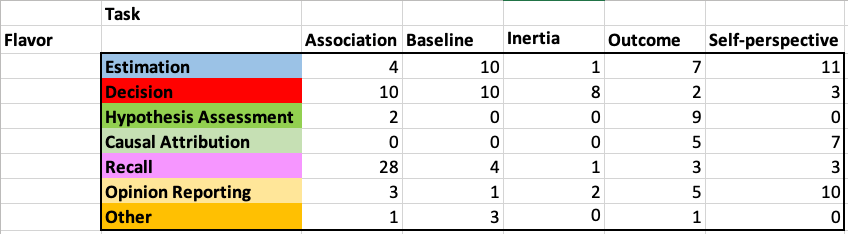
They organized all 154 biases into a table which I do not think I am allowed to post here. Instead, I made my own. In each cell I listed the number of biases.
Establishing base rates
Memorizing all biases would be a tough task. The point is, the categories are useful shorthand for finding which biases are being committed , and they can be subdivided into these flavors. Using extremely rough logic, we can see that the most common errors are Association based errors in Estimation situations (31%). Recall (25%) estimation (21%) and decision (21%) make up the majority (68%) of all errors. CRAZY.

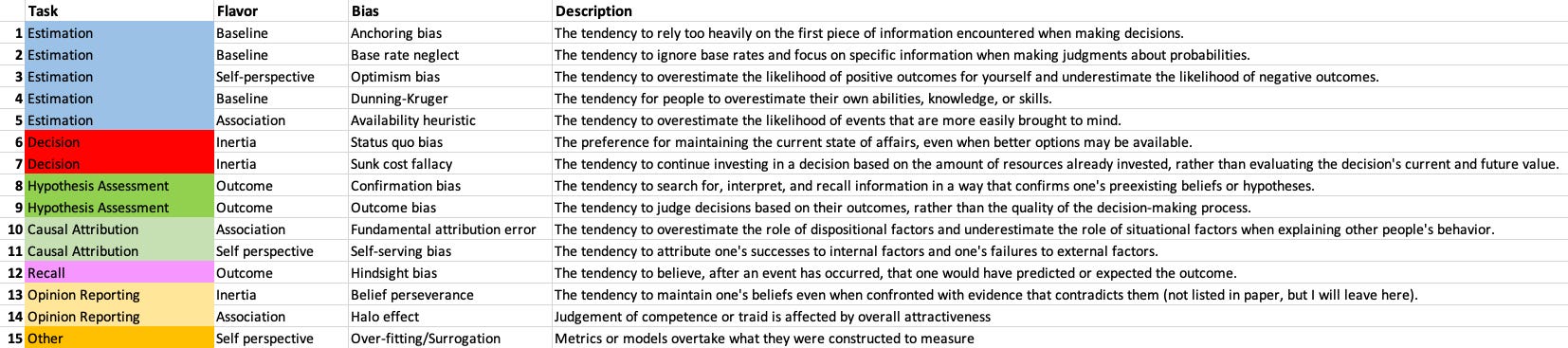
I have recreated the table with the most often cited biases and sorted them into the scheme offered above. Sorry, “sexual over perception bias” is not making it onto this list (although she was TOTALLY looking at me at the gym today). Here is a list of the most common biases according to Chat-GPT4, which I cross-referenced with the paper and Khaneman’s commentary in TFS. The list was auto generated according to the principles outlined in the paper.
Commenting on the Categorization
Interestingly, Chat GPT did very well at categorizing them, but disagreed with the authors on sub-categories. The reason for this is that the bias definition may change. For example, Optimism bias definition by Chat GPT simply stated that “tendency to overestimate the likelihood of positive outcomes and underestimate the likelihood of negative outcomes” whereas the authors added “ for oneself”. Thus, this bias was placed in the self-perspective category. This is also exemplified by the famous Dunning-Kruger, which by its definition has low ability people estimating their performance relative to a baseline. Thus, the subcategory is both baseline and self-perspective. Therefore, it should be noted that the categories are somewhat flexible and could probably be reorganized in a massive undertaking. What is important is how to integrate bias recognition into a wider framework of processing, which is what I will talk about in another post.
Thank you for reading, please comment regarding suggestions or errors.
Scenarios
Here are a few scenarios I generated. Use the framework above to see if you can ideantify the task, logic error and then bias in each scenario. Furthermore, some of the categories are ambiguous. As long as you can justify/recognize the bias type, youre good. Finally yes, this will require specific bias names, which are found elsewhere.
Scenario 1: You've been tasked with choosing a new supplier for your company. One option is a well-known company with a strong reputation, while the other is a smaller, local business offering lower prices. You decide to go with the well-known company to ensure quality and reliability, even though the local business could save your company some money.
1.1. What type of cognitive task are you engaging in?
A. Estimation B. Decision C. Hypothesis Assessment D. Causal Attribution
1.2. Is a cognitive bias present in this scenario?
A. Yes B. No
1.3. If yes, which sub-flavor of cognitive bias are you demonstrating?
A. Association B. Inertia C. Self-perspective D. Outcome E. Not applicable
1.4. If yes, which specific cognitive bias are you most likely to demonstrate?
A. Authority bias B. Confirmation bias C. Anchoring bias D. Status quo bias E. Not applicable
Answers: 1.1. B. Decision 1.2. A. Yes 1.3. D. Outcome 1.4. A. Authority bias
Scenario 2: You and a friend are discussing which brand of running shoes to purchase. Your friend has had a positive experience with a particular brand, while you've had a great experience with another. You both decide to stick with the brands you know and trust, even though there may be other options worth considering.
2.1. What type of cognitive task are you engaging in?
A. Estimation B. Decision C. Hypothesis Assessment D. Causal Attribution
2.2. Is a cognitive bias present in this scenario?
A. Yes B. No
2.3. If yes, which sub-flavor of cognitive bias are you demonstrating?
A. Association B. Inertia C. Self-perspective D. Outcome E. Not applicable
2.4. If yes, which specific cognitive bias are you most likely to demonstrate?
A. Confirmation bias B. Availability heuristic C. Self-serving bias D. Anchoring bias E. Not applicable
Answers: 2.1. B. Decision 2.2. A. Yes 2.3. A. Association 2.4. A. Confirmation bias
Scenario 3: You're trying to decide on a vacation destination. You've narrowed it down to two options: a beach resort and a mountain retreat. You've researched both destinations thoroughly, comparing costs, activities, and travel logistics. After considering all factors, you choose the beach resort because it offers more activities that you and your travel companions enjoy.
3.1. What type of cognitive task are you engaging in?
A. Estimation B. Decision C. Hypothesis Assessment D. Causal Attribution
3.2. Is a cognitive bias present in this scenario?
A. Yes B. No
3.3. If yes, which sub-flavor of cognitive bias are you demonstrating?
A. Association B. Inertia C. Self-perspective D. Outcome E. Not applicable
3.4. If yes, which specific cognitive bias are you most likely to demonstrate?
A. Confirmation bias B. Availability heuristic C. Self-serving bias D. Anchoring bias E. Not applicable
Answers: 3.1. B. Decision 3.2. B. No 3.3. E. Not applicable 3.4. E. Not applicable. In this scenario, the decision-making process appears to be thorough and well-reasoned, with no clear indication of a cognitive bias.
Reference
Cummins, R. A., & Nistico, H. (2002). Maintaining life satisfaction: The role of positive cognitive bias. Journal of Happiness studies, 3(1), 37.
Das, T. K., & Teng, B. S. (1999). Cognitive biases and strategic decision processes: An integrative perspective. Journal of management studies, 36(6), 757-778.
Dimara, E., Franconeri, S., Plaisant, C., Bezerianos, A., & Dragicevic, P. (2018). A task-based taxonomy of cognitive biases for information visualization. IEEE transactions on visualization and computer graphics, 26(2), 1413-1432.
Harding, E. J., Paul, E. S., & Mendl, M. (2004). Cognitive bias and affective state. Nature, 427(6972), 312-312.
Saposnik, G., Redelmeier, D., Ruff, C. C., & Tobler, P. N. (2016). Cognitive biases associated with medical decisions: a systematic review. BMC medical informatics and decision making, 16(1), 1-14.