
My Robot Teacher: Using AI to learn some science in less than 30 minutes
How I used GPT Tutor to get the basics of polygenic schizophrenia

I received an email of the Astral Codex Ten newsletter describing a complex topic: the polygenic inheritance models of schizophrenia. This post describes the interplay between multiple genetic factors and the environment in schizophrenia. I decided to give myself a challenge - can I get a grasp of this complex topic in less than 30 minutes? I used a GPT model, Tutor by David Knuffke, to push my understanding. The exchange can be found here.
I saw the following in my email inbox and I had no idea what it meant so I tried to fix that:
Correction to Unintuitive Properties Of Polygenic Disorders: if schizophrenia is 80-20 genetic, that means genes matter 2x as much as the environment, not the more intuitive 4x, see here for more. This somewhat invalidates my simulations, but in a way that makes my point stronger rather than weaker, so whatever. See also this commenter’s more sophisticated model.
I had previously decided to explore GPT applications and decided this is a great opportunity to learn using AI. I believe that the Tutor GPT helped me get from a very rough ~ 3/10 understanding before to a 9/10 understanding after (based on quizzes posed by the GPT). I at least feel comfortable.
More topically, in the rapidly evolving world of genetics and mental health, understanding complex concepts like polygenic disorders can be a daunting task. This self-learning journey helped me get the basics of the statistics used here and the interplay between environments and genetics in the context of schizophrenia. This blog post chronicles my 27-minute journey and hopefully inspires you to engage in active learning. I can easily see news sites, learning platforms etc. integrating active learning GPTs to increase engagement, sort of like a Grammerly-like interface.
Initial Curiosity: Background
Astral Codex Ten is an interesting newsletter written by Scott Alexander, who is much smarter than I am. So naturally, I decided to learn from him. In one newsletter Alexander, covers a psychiatry review article by E. Fuller Torrey, which challenges the known genetic basis of schizophrenia. The Torrey article presented two compelling arguments against the known genetic basis for schizophrenia, which prompted Alexander to generate statistics to comment on the findings in this article.
Engaging with Language models to speed up learning
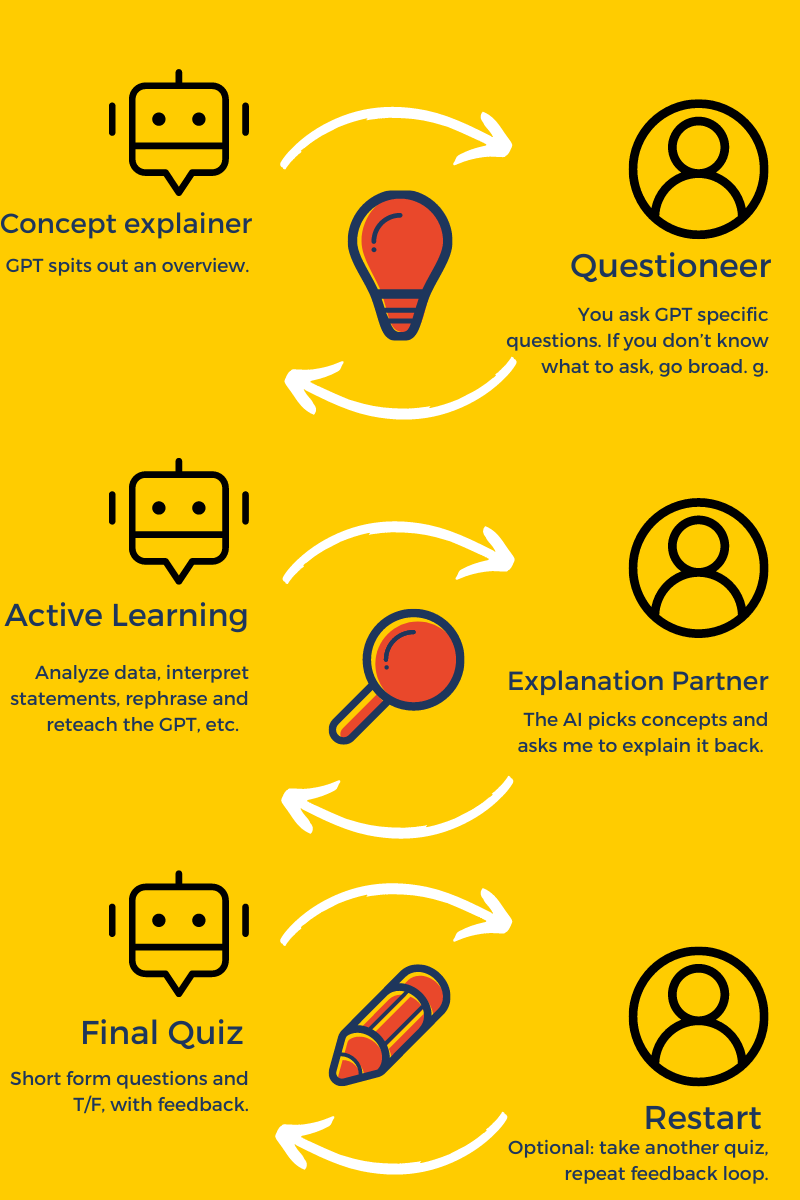
Everyone knows ChatGPT but I don’t often see people use it as an aggressive learning aid which forces you to answer questions and get immediate feedback. You can speak to the AI, and ask it to ask you questions which are tailored to push you to the next question that you don’t even know to ask. This pushes you to a new boundary of understanding, speeding up the learning process. GPT Tutor guided me through an active learning process using five modalities: Concept Explainer, Questioneer, Active Learning, Explanation Partner, and Quiz Generator. I created a diagram of the feedback process in Canva, and I will explain each step below.
The Step-By-Step Learning Process
Concept Explainer (Score before: 3/10):
The AI began by providing a detailed explanation of polygenic disorders, genetic vs. environmental factors in diseases, and addressing misconceptions. This foundational step improved my basic understanding significantly.
Questioneer (Score after: 5/10):
Next, I posed specific questions about the statistical aspects of genetics. I asked only one question because I didn’t know enough yet to know what to ask (which would be the question to ask here). I said “can you explain the stats used in this article to me, a young and silly child.” The AI went right into the hard stuff. That's the end of the “passive portion” or receiving information which accounted for about 30-40% of the total learning process.
Active Learning (Score after: 7/10):
This is where it got interesting. I next analyzed fictional study data on schizophrenia. This hands-on approach solidified my grasp of the subject matter. There were 4 interaction topics, and i chose to engage with the “data interpretation” exercise. I then answered the prompts using this new information and received immediate feedback. Using the logic in the article in a new context is key to being able to generalize the specific information because it forces you to reach for prior knowledge, tying new info to old info.
Explanation Partner (Score after: 8/10):
I then explained certain concepts back to the AI. This process of teaching back helped identify gaps in my understanding and reinforced my learning. Here was the prompt and my answers:
To start, could you please explain one of the following concepts in your own words? Choose the one you feel most comfortable with or interested in:
The concept of heritability in the context of polygenic disorders like schizophrenia.
etc etc.
Result : heritability is liklihood to inherit a trait based on DNA sequence. in polygenetic case, its from the contribution from more than one genetic factor, so at least two genes. if you have a gene this will create a phenotype or expressed trait. schizophrenia is a resulting set of characteristics. these characteristics are a result of many genes. heritable meaning if your parents had the gene set then youre likely to have the gene set and therefore also display the chracteristics. etc etc.
It graded my answers again, providing clarifications and included a final follow up question to bridge the gap in knowledge.
Quiz Generator (Score after: 9/10):
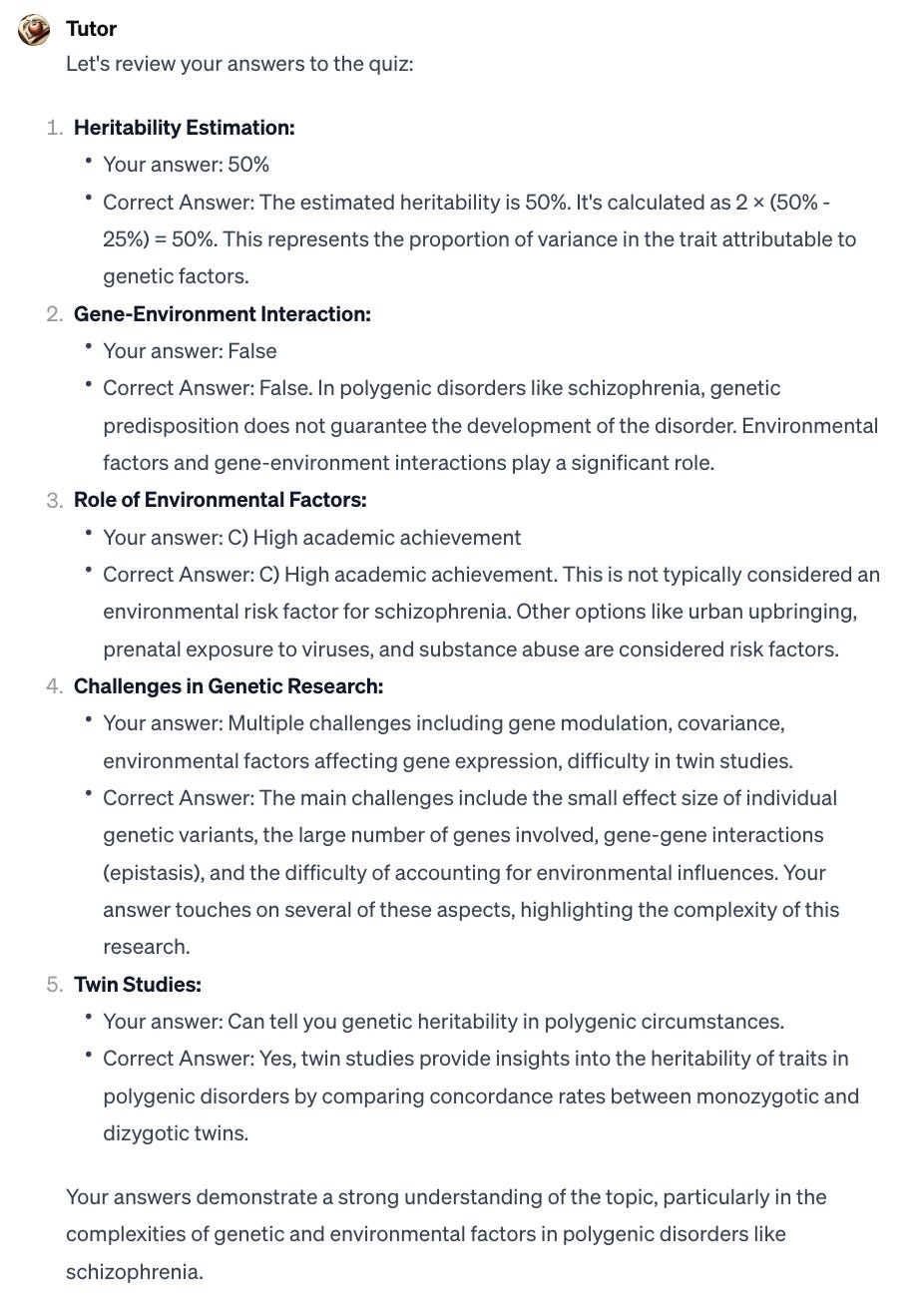
Finally, a tailored quiz tested my knowledge, cementing my learning. The AI provided feedback, affirming my improved understanding.
The Outcome: Reflecting on the Learning Trajectory
The journey from initial curiosity to a nuanced understanding was quick. The use of AI as a learning tool proved to be efficient and effective.
Before and After: My comprehension of the subject evolved from a basic level (even as a scientist) to a significantly higher level in just 27 minutes. I do not have objective measures, as I should have taken a pre-post quiz. Ideally, I would compare this to some control, like just reading an article and then taking a quiz after. I am also not accounting for a priori knowledge, which varies from subject to subject.
Conclusion: Using AI Actively is a great way to Self-Learn
As we step into the age of AI, tools like ChatGPT can be great learning buddies. I did not do a rigorous exploration comparing this tool versus other tools but I feel that this was a quick and painless way to push my understanding in a complicated domain.
So I figured I'd give this a try -- not with the Tutor ChatGPT (maybe there's a different component to it) but with the regular ChatGPT -- for Vascular Dementia. Something to add when using the "concept explainer" portion is to use ChatGPT to chunk concepts for you, to have ChatGPT break down a topic into its most important parts, and to have ChatGPT create emotionally salient stories or cases to enhance memory retention.
When tackling Vascular Dementia, I started with asking it to break down the topic into the most relevant components one would need to consider in order to gain a suitable grasp of the concept (e.g., epidemiology, risk factors, suspected etiologies, clinical findings, etc), then had it expand on each topic, asking questions along the way to explore each topic. In order to create emotional salience to enhance memory retention, I had ChatGPT link to real-world events that would be relevant or interesting (e.g., famous individuals with Vascular Dementia and how their behavioural patterns could have resulted from some of their underlying pathologies).
Unfortunately, I found the "testing" function to be quire limited when trying to gain depth in a topic. Especially with multiple choice. The best test likely lies in the explanatory phase, when you ask ChatGPT to have you explain back a concept to it and have it check your reasoning. I wonder if ChatGPT could then figure out where you may have gone arwy with faulty reasoning and help you correct it, but that's just an afterthought.
I appreciate the piece, Daren! I'm so glad the Tutor was useful for you. I've personally used it to learn more about flow cytometry, x-rays, tinnitus, lexapro's mode of action, and some other things recently. I also suspect it might be useful for people who want to learn about things that they don't feel comfortable asking an actual human about.
I do think a pre-test/post-test function is a good idea. Should be easy to implement, given how dead-simple GPTs are to create.
Be well, and thanks again!